
You obtained, or are applying for, Slovak citizenship by descent. Does the passport make you a Slovak taxpayer? What descendants living abroad owe in tax, health insurance and military service, and the one rule that can cost you the citizenship.
Slovak citizenship by descent is the route for people whose parent, grandparent or great-grandparent was a Czechoslovak citizen born in the territory of today’s Slovakia (Section 7 paragraph 8 of the Citizenship Act). If you are applying on that basis, or already hold a Slovak passport obtained through your ancestry, this article is written for you.
Applicants by descent are in a different position from every other new citizen: most have never lived in Slovakia and do not plan to move there. So the questions they ask come after the oath. Will Slovakia tax my income once I hold its passport? Do I have to pay Slovak health insurance? Can my son be called up for military service? Can I lose the citizenship again?
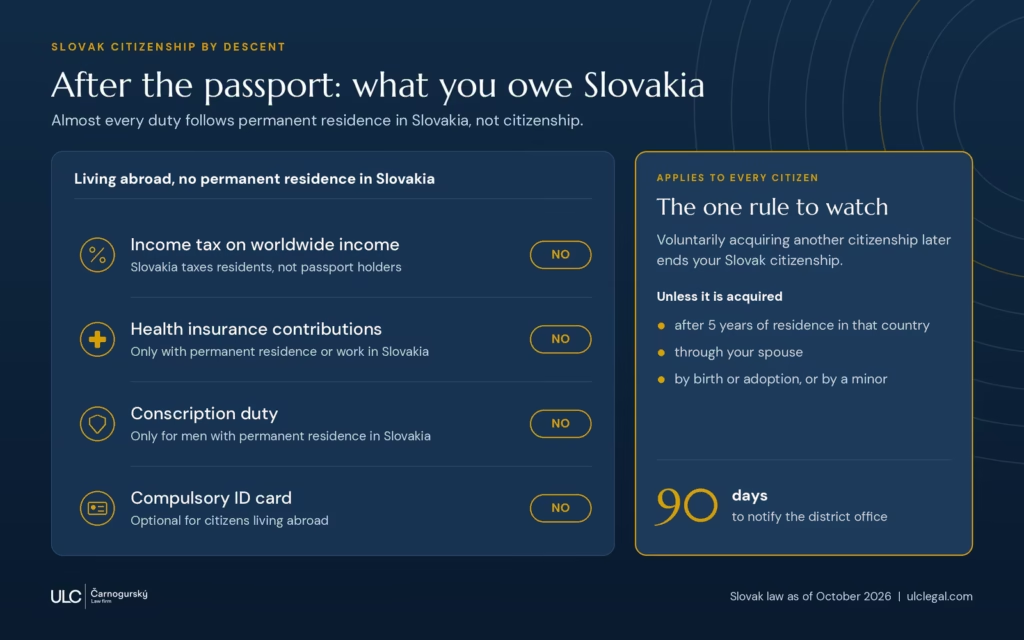
The short answer is reassuring. Almost every ongoing obligation under Slovak law is tied to permanent residence in Slovakia, not to citizenship. A descendant who becomes a Slovak citizen and continues living in the United States, Canada, Australia or the United Kingdom takes on very few duties. There is, however, one rule that can cost you the citizenship if you overlook it, and it is explained below.
Eligibility and the application itself, including the July 2026 amendment that removed the residence permit requirement for descendants, are covered in our guide to Slovak citizenship by descent.
At a Glance: What Citizenship by Descent Does and Does Not Trigger
| Question | Triggered by citizenship alone? | What actually triggers it |
|---|---|---|
| Slovak income tax on worldwide income | No | Permanent residence, a home in Slovakia, or 183 days of presence in a calendar year |
| Public health insurance contributions | No | Permanent residence in Slovakia, or employment or business in Slovakia |
| Conscription duty | No | Male citizen from the year he turns 19 who has permanent residence in Slovakia |
| Duty to hold a Slovak ID card | No | Citizen aged 15 or over with permanent residence in Slovakia |
| Loss of Slovak citizenship | Yes, this applies to every citizen | Voluntarily acquiring another citizenship later, unless a statutory exception applies |
Do You Pay Tax in Slovakia After Obtaining Citizenship by Descent?
No, not because of the passport. Slovakia taxes on the basis of residence, not nationality. Under Section 2 letter d of the Income Tax Act (Act Number 595/2003), a person has unlimited tax liability in Slovakia only if they have permanent residence in Slovakia, have a home there, or are habitually present there. Citizenship does not appear in the definition at all.
Habitual presence means at least 183 days in the calendar year, continuously or in several periods, and every day counts, including days of arrival and departure. A home means accommodation that is not merely occasional, combined with a clear intention to stay there permanently in light of your personal and economic ties.
If none of these applies, you are a non-resident for Slovak tax purposes. Non-residents are taxed only on income from Slovak sources, for example rent from a Slovak property or salary for work performed in Slovakia. A Slovak passport on its own does not create a duty to file a Slovak tax return.
The Trap: Registering Permanent Residence You Do Not Use
Once you are a citizen, you can register permanent residence in Slovakia, and some new citizens do it for convenience, for example at a relative’s address. Be careful. Permanent residence is the first of the three statutory tests, so registering it brings you formally within the definition of a Slovak tax resident even if you never spend a night there. In most cases a double taxation treaty then resolves the conflict in favour of the country where you really live, but you would be relying on a treaty tie-breaker rather than on a clean position. The same registration is also what triggers health insurance, conscription duty and the ID card duty described below.
Our advice is simple: register permanent residence in Slovakia only when you genuinely move there.
A Note for US Citizens
The United States taxes its citizens on worldwide income wherever they live. Acquiring Slovak citizenship does not change your US obligations, and it does not add Slovak ones as long as you are not a Slovak tax resident.
Health Insurance: No Contributions, but No Automatic Cover
Compulsory public health insurance follows the same logic. Under Section 3 of the Health Insurance Act (Act Number 580/2004), the insured person is someone with permanent residence in Slovakia, or someone without it who works or runs a business in Slovakia. A citizen living abroad without Slovak permanent residence is not in the system and owes no contributions.
The other side of this is equally important. The passport does not give you Slovak health cover. If you later move to Slovakia and register permanent residence, you enter the system and the duty to pay contributions begins.
Military Service: What the Law Says About New Citizens
Slovakia has a professional army and no compulsory peacetime service. What remains is a conscription duty, which is the duty to undergo a draft assessment and to perform extraordinary or alternative service if it is ordered. Under Section 5 of Act Number 570/2005 this duty arises for a male citizen on 1 January of the year in which he turns 19, if he has permanent residence in Slovakia.
The Act addresses new citizens directly. A man who acquires Slovak citizenship after that date becomes subject to the duty from the day of acquisition, again only if he has permanent residence in Slovakia. A citizen who lives abroad and later registers permanent residence in Slovakia becomes subject to it from the day of registration. The duty ends when permanent residence in Slovakia ends, and in any case at the end of the year in which the citizen turns 55.
For a family living overseas this means that neither you nor your sons are subject to Slovak conscription duty while you have no permanent residence in Slovakia.
The One Rule That Can Cost You the Citizenship
Slovakia accepts that applicants by descent keep the citizenship they already hold. The risk lies in the future. Under Section 9 paragraph 16 of the Citizenship Act (Act Number 40/1993), a Slovak citizen loses Slovak citizenship on the day they voluntarily acquire a foreign citizenship on the basis of their own application, declaration or similar act.
There are exceptions. Slovak citizenship is not lost if the foreign citizenship:
1. is the citizenship of your spouse and is acquired during the marriage,
2. is acquired by birth or adoption,
3. is acquired by a minor child, or
4. is the citizenship of a state in which you had permitted, registered or otherwise recorded residence for at least five years at the time of acquisition, and you actually lived there during that time.
In each of these cases you must notify the district office in the seat of a region in writing within 90 days of acquiring the foreign citizenship and submit documents proving it.
A practical example: an American who obtains Slovak citizenship by descent and moves to Germany can later naturalise as a German after five years of registered residence without losing the Slovak passport, provided the notification is made on time. The same person acquiring a third citizenship through an investment programme, without having lived in that country for five years, would lose Slovak citizenship automatically.
The First 90 Days After the Oath
You become a citizen at the moment you take the oath and receive the certificate of grant of citizenship. Since 15 July 2026 the certificate itself serves as proof of Slovak citizenship, but only for 90 days from the day you receive it (Section 9a paragraph 1 letter e of the Citizenship Act). Use that window.
Register your birth in the special registry. Births, marriages and deaths of Slovak citizens that occurred abroad are entered in the special registry kept by the Ministry of Interior (Section 23 of the Registries Act, Act Number 154/1994). You can apply through a Slovak embassy or consulate. The entry is made within three months, a period that can be extended by up to three more months, and you receive a Slovak birth certificate. If you are married, register the marriage as well.
Then apply for the passport. The Slovak birth certificate is the document you will typically be asked for, so starting the registry application immediately after the oath saves months.
The ID card is optional. Under Act Number 395/2019 only citizens aged 15 or over with permanent residence in Slovakia must hold one. Citizens living abroad may apply for it but do not have to.
Your Children: Born Before or After Makes a Difference
A child acquires Slovak citizenship by birth if at least one parent is a Slovak citizen at that time (Section 5 of the Citizenship Act). Children born after you take the oath are therefore Slovak citizens from birth, wherever they are born. Their birth should be entered in the special registry.
Children born before you became a citizen do not acquire citizenship automatically. Two points matter here. First, a minor child can be named in the parent’s own application, which requires the consent of the other parent. Second, the descent route reaches only as far as a great-grandparent. If your own claim rests on a great-grandparent, that ancestor is your children’s great-great-grandparent, and they cannot rely on the descent route independently once they are adults.
For families this is the single most important planning point: decide how the children will be handled before the parent’s application is filed, not afterwards.
Rights You Gain Without Moving
Citizens without permanent residence in Slovakia can vote by post in elections to the National Council, the Slovak parliament, after applying to be entered in the special list of voters (Section 57 of Act Number 180/2014). And as a citizen of a European Union member state you hold EU citizenship, with the right to live and work in any member state.
Frequently Asked Questions
Will Slovakia tax my foreign salary or pension once I am a citizen?
Not on the basis of citizenship. Slovak worldwide taxation applies only to tax residents, which means people with permanent residence, a home or at least 183 days of presence in Slovakia in the calendar year.
Do I have to file anything with the Slovak tax office every year?
Not merely because you are a citizen. A filing duty arises only if you are a Slovak tax resident or have taxable income from Slovak sources.
Do I have to register an address in Slovakia?
No. Citizens living abroad are not required to have permanent residence in Slovakia, and registering one has tax, insurance and conscription consequences.
Can my son be drafted?
Conscription duty applies only to male citizens with permanent residence in Slovakia. Without it, the duty does not arise.
I already hold two citizenships. Is Slovak citizenship a problem?
Citizenships you held before the grant are not affected by the loss rule. The rule concerns foreign citizenships you voluntarily acquire after becoming a Slovak citizen.
Planning Beyond the Passport
Obtaining citizenship by descent is one legal step. Structuring what comes after it, including tax residence, children, registry entries and any later move to Europe, is where mistakes are most often made. ULC Čarnogurský advises descendants of Slovak emigrants on both.
Schedule Your Free Consultation
Disclaimer: This article provides general information about Slovak law as of October 2026. It is not legal or tax advice. Tax residence in particular depends on your individual circumstances and on the double taxation treaty between Slovakia and your country of residence. For advice specific to your situation, please schedule a consultation with our legal team at ULC Čarnogurský.